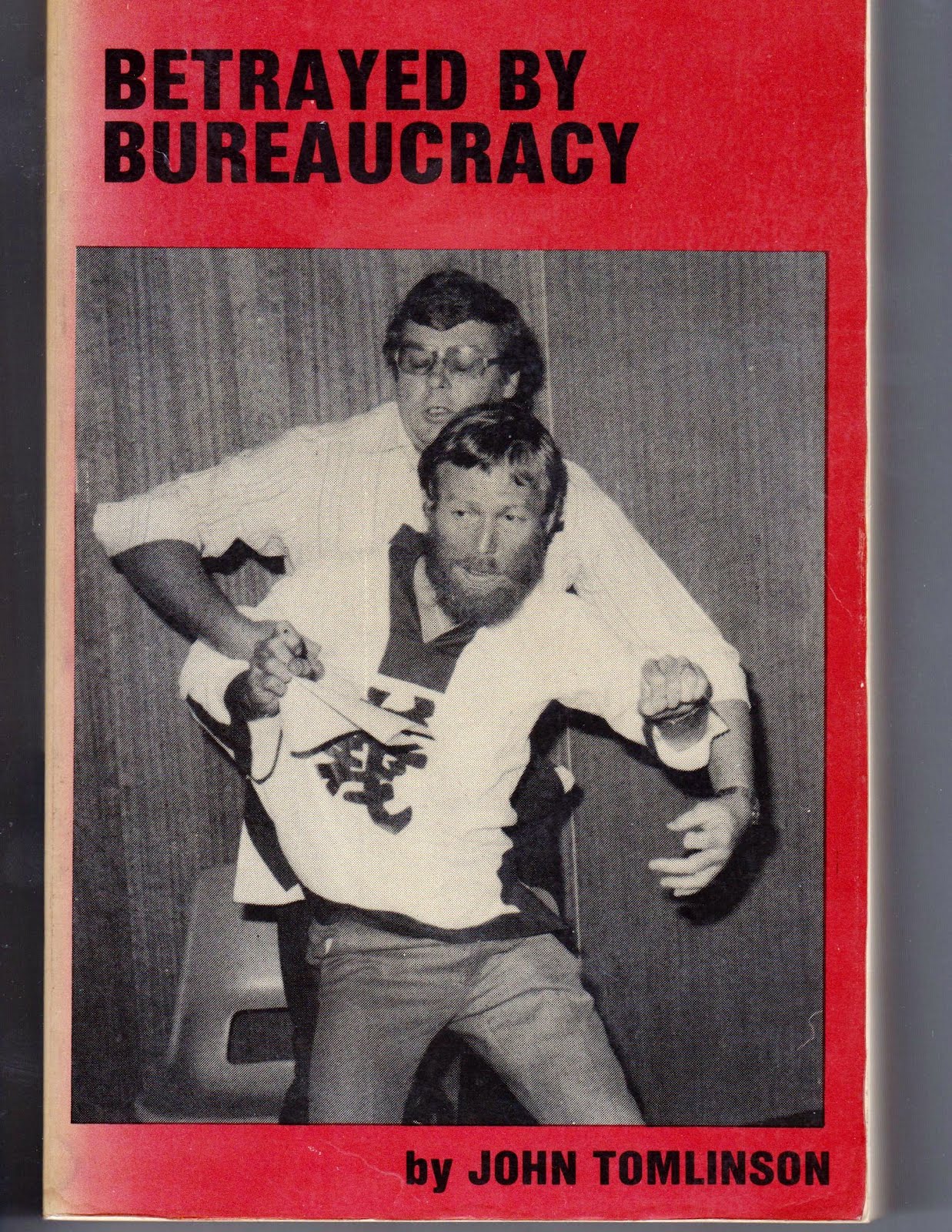
Dr Tomlinson facetiously helping police with investigations.
In the annals of Northern Territory activism , the name of Dr John Tomlinson looms large. His relentless pursuit of social justice for the many, his drive to reform government welfare departments , strong opposition to uranium mining and his act of returning an Aboriginal girl, lodged with European foster parents in Darwin, to her family in Arnhem Land made him nigh on notorious . At one stage , it is said , he was the second person after Frank Hardy, author of the controversial Power Without Glory , charged with criminal defamation ; there was further uproar when it was claimed he was teaching what amounted to sabotage at the Darwin Community College and he used photographs of himself struggling with arresting police on the front cover of a two -in -one book which severely criticised Australia’s social welfare system, especially as applied in the Territory.
On top of these monumental rows , he managed to wet numerous fishing lines and take a keen interest in the welfare of Territory fishing grounds and the environment in general. He delighted in returning from fishing trips and alerting Darwin port authorities over the radio that his fishing smack , provocatively named Yellow Peril, was about to enter Australian waters.
From Queensland , he had worked as a clerk and then a cadet scientist with the Queensland Department of Agriculture and Stock, studying at night school for his matriculation. At the University of Queensland , he joined and subsequently led the Left wing Student Action and was involved in the Aboriginal Land Rights struggle with Aboriginal poet Oodgeroo Noonuccal ( Kath Walker).
After marrying high school teacher ,
Clare Priest, he graduated in
Social Work in 1964 and worked with the
Commonwealth Department of Social Services for nine months before transferring to the
Welfare Branch in
Darwin, which controlled the lives of Territory Aboriginals. Tomlinson , in supplied biographical notes, said he was constantly " in strife " with the hierarchy at the branch , headed by
Harry Christian Giese –nicknamed “
Do it my way” by John .
Babe Damaso, an Aboriginal welfare officer , took the "
cocky Tomlinson" under his wing and attempted to
instil in him a sense of humility and
patience . Babe also taught him most of what he
knows about fishing in the Top End. 
In 1967 , Tomlinson published his first book of poems REFLECTIONS OF A FOOL , printed by Coleman Printers ,Smith Street. He called the venture Wobbly Press as his writings were in line with the International Workers of the World- the Wobblies. Brian Manning ran off the text on a roneo machine atop a shaky desk in the Waterside Workers’ Union office on Stokes Hill Wharf.
Tomlinson returned to Social Services , Brisbane, in 1968 and through part-time study completed an undergraduate Arts degree . The next year he undertook an Honours degree in Anthropology and Sociology. In 1970 he was granted a two year full-time Commonwealth Public Service Post Graduate Scholarship to undertake a Masters in Social Work study , working with Aboriginal and Torres Strait Islander citizens of South Brisbane. His study showed that a community work approach, which listened carefully to what Indigenous people wanted, allowed the majority of the community to achieve things that individualised counselling could not provide.
This , he says , is a lesson that the current Federal Government and/or Opposition would do well to heed if they were really interested in using evidenced-based social policy. In 1973, he returned to the Welfare Branch in Darwin as a grade 2 social worker, acting grade 3, with responsibility for the Top End of the NT. His friend, Colin Clague, (featured in the SBS documentary When Colin Met Joyce) had responsibility for the southern half of the Territory.
Shortly after returning to Darwin, whilst living in a house adjoining Essington House remand and detention centre on McMillans Road , he heard screaming emanating from the building . He raced across and insisted that he talk to the young girl who had screamed. He was taken to her cell and there was silence. The staff wanted him to leave saying ,“You see all is well now”. He insisted he speak to the girl. When the door was opened the thin, young Aboriginal woman was semi-conscious hanging from a sheet. She recovered.
Things went well for Tomlinson in the first eight months of 1973; Ray McHenry , the new head of the department, was a breath of fresh air- until the matter of Tomlinson returning the young Aboriginal girl to her father created an almighty rumpus which reverberated around the world . She had been fostered with a white family after a difficult birth. Her brother had also been fostered by the same family, again after a difficult birth ,but he had been returned to his natural parents at the age of four . She was seven and the foster parents did not want her to return. With the help of Bill Ryan, the Director of North Australian Legal Aid, she and her father returned to a remote Maningrida outstation. After a public service inquiry, Tomlinson was demoted to social worker class 1. Les MacFarlane, Speaker of the NT Legislative Assembly, telegrammed the department saying, "Can’t you demote Tomlinson one more grade."
This major incident led to the first social work strike in Australia, with all but one of the branch’s social workers striking for three weeks in support of Tomlinson’s returning the girl to her natural parents. The return gave impetus to other social workers around Australia who were attempting to keep Aboriginal children in their own communities.
The NT Council for Civil Liberties

After this, Tomlinson was not given an office nor was he given any duties. In order to fill in the day he caught up on all the social science reading that he had put aside during the previous year. That done, he set out to research the emergency income support policies and practices of the branch and commented critically upon policy and activities in letters to the Minister and the Prime Minister. Eventually senior people in the branch decided he might be less of a problem if he was put to work.
In 1974, Robert Wesley-Smith, Jan Tokarcyz, Clare and John Tomlinson, Maggie Kent and others called a public meeting to set up the NT Council of Civil Liberties. That meeting was " gate-crashed" by what he described as " 200 police" who won most of the motions and who then stacked the interim council with police and magistrates. [ This seems an extraordinary figure, as if Public Enemy Number 1 was on the premises .] The only motion which the originators of the plan for a Council of Civil Liberties succeeded in getting passed was to set the time, date and place for the next meeting, three months hence.
Cyclone Tracy intervened. Tomlinson was put in charge of issuing Emergency
Purchase Orders for petrol and supplies for people who had lost houses and those who were evacuating. When the
Navy relief vessels arrived, the head of one of the trucking companies with a contract to
pick things up from the wharves and take them to emergency centres came in and asked for a voucher to supply all his trucks.
Tomlinson gave him the voucher. About an hour later,
all hell broke loose.
He had exceeded his financial delegation a hundred fold. After two weeks Tomlinson was sent to set up the
Northern Suburbs emergency relief office in the Casuarina High School.
Three months after the initial meeting of the
Council of Civil Liberties, the police officer who had been
elected interim secretary placed an advertisement in the
NT News declaring the planned meeting of the
CCL had been abandoned due to the cyclone. But at the appointed hour of 8pm a
small band of the
originators and Tom Pauling, later the Administrator ,who had been elected to the Council’s interim executive, entered the rubble-strewn ruins of
Brown’s Mart (the agreed site for the subsequent meeting) and a motion was moved
thanking the interim committee for their efforts and disbandening them.
An election of new office bearers was then held. Regional Council of Social Development (RCSD)
After Cyclone Tracy, former
Lord Mayor of Brisbane,
Clem Jones , was appointed El Supremo of the
Darwin Reconstruction Commission. There were
undoubted sighs of relief among senior staff at the Welfare Branch when Tomlinson took leave from the public service to work as the
Social Planner with the Regional Council of Social Development, which was part of the Australian Assistance Plan. One day, a member of staff, Kass Hancock asked him to go to the hand over by Jones , to RCSD, of a demountable office in Casuarina. The speeches were mercifully short, much to the relief of several senior Commission staff.
Jones said something like, "Well that was short and sweet, we have an hour or so till the next appointment". Tomlinson , one of whose brothers-in-law had had a lot to do with Clem, suggested adjourning to the Marrara Hotel for a cold beer. After a couple, Clem asked ,"Well, while we’re here, is there anything else we can do for you?" Tomlinson replied, "You could knock down the cellblocks of the Essington House remand centre." When asked why, Tomlinson told of the night the young girl had nearly died and a couple of other horror stories he had heard about the place from staff who had worked there. "Where is it?" Clem asked. "Just across the road" several people chorused. The group piled out of the pub and drove the 150 metres to the remand centre. Most of the open part of the centre had been badly damaged but the cellblocks were still intact.
Jones found a place to sit about 80 metres from the cellblocks and dispatched his senior engineer and senior architect to inspect the site. Clem demanded more details of the young people who had been locked up there and the reasons for their incarceration. About 20 minutes later the engineer and architect returned and announced that whilst the main building would need to be demolished the cellblocks were structurally sound but would need re-roofing. Clem exploded: "Structurally sound- my arse! I can see significant cracks in the walls from here." Engineer and architect beat a hasty retreat in the direction of the cellblocks, returning five minutes later , confirming they too could now agree there were structural faults and recommended immediate demolition because of the safety hazard the site presented. Clem pointed to the completely intact gymnasium and asked "Do you want that knocked down too?" Kass replied , "No, we plan to hold dances there for young people."
One of the workers in the RCSD, Clive Scollay, was using low cost video cameras to help people get on with life after the cyclone. One afternoon there was a rumpus on the footpath in Smith Street opposite the RCSD office. A police officer had an Aboriginal youth on the ground. Tomlinson went down and remonstrated with the officer when it appeared to him that unnecessary force was being used. Clive filmed the event from the RCSD office.
The Council of Civil Liberties took the videotape to the Commissioner of Police and complained. alleging excessive use of force. A copy of the tape was kept in the RCSD office. Some months later the office was broken into and apart from the petty cash tin the only other thing that was identified as missing was a hand- drawn poster behind the lunch room door calling for an experienced sapper unit to do some explosive operations in the uranium province. That poster was in Tomlinson’s handwriting. It was assumed by some that the break-in was the work of ASIO or the Special Branch.
Some years later ,when the videotape was handed back to the Council of Civil Liberties, Tomlinson, in his capacity as secretary, asserted the tape had been doctored. Considerable Press interest was aroused, the Police Commissioner claimed to have been criminally libelled. Tomlinson arranged to get a copy of the original tape sent up by Clive Scollay . Tomlinson agreed to play both tapes to the police and arranged to have a journalist and a cameraman from NT News at theviewing .
After the screening,
the police produced a search warrant, which Tomlinson
read and then refused to relinquish, demanding a copy be given to him. A struggle ensued which the cameraman dutifully recorded and the
front cover of next day’s News was entirely devoted to photos of the struggle.
In a book some years later, Tomlinson used the photos with the caption "showing the author helping the police with their enquiries".[ Both copies of the videotapes were the same. For those who believe in
conspiracy stories and UFOs , it was said that, at the time of the
break-in of the RCSD office, the doctored tape was inserted in the box containing the original footage, which was removed.
Richard Nixon would surely
not have had to resign had there been
such skilful plumbers working for him, instead of the
Watergate amateurs.]
Tomlinson was charged with a number of offences, but barrister Geoff James, took an action in the Federal Court that found the search warrant had been insufficiently precise and police had exceeded their powers. The charges were eventually dropped.
Tomlinson became one of many Darwin activists who campaigned against the Indonesian invasion of East Timor . He was involved in the 1976 attempt to take a boatload of medical supplies to East Timor on the vessel Dawn . Intercepted by the Navy , those aboard were skipper Manolis "Manny" Mavromatis , Darwin agronomist Robert Wesley-Smith, James Zantis, of Bondi, Sydney , and Harold Clifford Morris ,of Deniliquin, NSW. Wesley-Smith had asked Tomlinson to take some of the supplies down to the Quarantine Station boat ramp to rendezvous with Dawn. Tomlinson’s car was being serviced , so he used the RCSD Kombi van to deliver the supplies. That night the Dawn was intercepted by a Navy boat as it attempted leave Darwin Harbour and all four on board were arrested. Tomlinson was arrested the next day and charged with aiding, abetting, counselling and being concerned with the illegal export of goods and being on Quarantine Station without permission. The late David Scott, Director of Community Aid Abroad, said it was "about time a social worker was charged with counselling." Customs seized both the vessel and the RCSD Kombi van .[More details of this in the next exciting post of the Rob Wesley-Smith series ].
The RCSD was involved with setting up children’s playgroups in the rural area, a prisoners' support group, a housing advocacy program, the Darwin Homemaker Service designed to help families who had been in Housing Commission homes destroyed by Tracy whom the Commission no longer wanted to house, and the Darwin Community Welfare Union, which in subsequent years morphed into the Darwin Unemployed Workers’ Union that held, on the parklands above Lameroo Beach, the Dole Bludgers Picnic at which 3000 people were wined and dined (thanks to the generosity of local businesses). In a later manifestation this Union became "Colie"- the Coalition of Low Income Earners and succeed in providing low cost accommodation .
Darwin Community College
In May of 1977, Tomlinson , a lecturer at the
DCC, was the centre of
a major argument about
academic freedom when it was alleged
he advocated sabotage in a course for the
Associate Diploma of Community Work. Police were sent to the college without prior consultation with
the acting principal .Once again he was the subject of lively debate in t
he media and parliament. Many students from this course did field placements at the Unemployed Workers’ Union and Colie.
For a couple of years Tomlinson published a small monthly magazine entitled Farewell to Alms, a play on the Hemingway novel. As its name suggests , he wanted to see the welfare system disassociate itself from the poor law charity system and embrace universal income guarantees such as a guaranteed minimum income. In one issue ,Tomlinson wrote an article in which he alleged that the Director of NT Welfare was murdering Aboriginal children by severely limiting their access to welfare payments. He states his luck luck with the law ran out at this point and he became the first person after Frank Hardy to be charged with criminal libel in Australia.
Tomlinson and Darwin lawyer , Geoff James , flew to Sydney to see a barrister who pointed out that, among other things, in order to prove "murder" it had to be shown that the accused had by his or her actions committed an act that directly led to the death of a specific person. Tomlinson’s arguments about statistical increases in Aboriginal babies dying simply wouldn’t stand muster. The Sydney barrister urged Tomlinson to make a complete retraction.
Geoff James took him across the road to a pub and said "Did you enjoy that? I hope you did because that hour just cost you $1200 and if we get him to defend you then you are looking at a minimum of $20,000. What did your last book cost to print?" Tomlinson issued the apology ,the criminal libel charges were dropped.
In a later edition of Farewell to Alms, Tomlinson alleged that by making it hard for parents to get welfare payments, it resulted in increasing numbers of Aboriginal children dying in remote parts of the NT. He was sued for libel and an out of court settlement of $5000 was reached.
In 1982, Tomlinson published Social Work: Community Work / Betrayed by Bureaucracy. In 1983, after sitting through an inquest into the death of an Aboriginal prisoner who had escaped from Darwin Hospital’s psychiatric ward, was recaptured and subsequently mortally injured , Tomlinson published a play entitled The Death of Phillip Robertson. After a reading at Brown’s Mart in October 1985 there was an eight week season at the New Theatre, Newtown, Sydney, beginning in December 1988.
In 1983/84, the Darwin Community College commissioned an external review of the Community Work course and despite the review recommending its continuation , the DCC executive committee , consisting of Director Joe Flint and Chairman, Nan Giese , lowered the boom. Tomlinson was made redundant in late 1985.
People’s Poems and Struggles * Tomlinson bites mud crab instead of fat cat . A Black Snake once sank its fangs into John at Fogg Dam and he spent a night in hospital.
In 1986 he studied full-time for his PhD. at
Murdoch University, his marriage to Clare breaking up late that year. His degree was finally awarded in 1989. In 1987 he was appointed
Director of the ACT Council of Social Service and lived in
Canberra until 1993 when he was appointed
Senior Lecturer in Social Policy and Community Work at the Queensland University of Technology.
A poem he wrote in 1994 raised the plight of the Timorese. Dr Tomlinson retired from the QUT position in 2006. His latest book of poems and song lyrics (published in 1999) was entitled People’s Poems and songs of Struggle. His foreword said the collection had been published in the hope that those who read would be inspired to make the world a better place. Many of the pieces had arrived in their present form due to the craft of Penny Harrington and Peter Hancock. Many of the works had been read on picket lines, public meetings, demonstrations , lectures, fund raisers and sit ins. In 2007, he married Penny Harrington, his long- time partner. After having reluctantly sold his boat and trailer bearing protest stickers , he recently got among the fish in New Zealand , writes and does his bit to urge governments and oppositions to adopt universal income support policies, to end the NT Intervention and treat asylum seekers humanely. NEXT : Dr Tomlinson’s plan to lift the income of the poor.