Wednesday, February 27, 2013

TOWNSVILLE DOWN IN THE MOUTH


Townsville’s prominent landmark-Castle Hill- which towers over the North Queensland city, is be renamed Mount Cavity following the discovery that it is crumbling and needs expensive root canal fillings . This comes a week after a dental company obtained naming rights to Townsville’s football stadium , home ground of the clean, green , nil additives Cowboys. The stadium is now known as 1300SMILES. The latest photograph of Castle Hill (above ) reveals the extent of the dental repair work that has to be carried out by the Townsville City Council. Clearly visible is the gummy state of the hill which could cause the entire edifice to collapse and slide into The Strand. Heavy–footed early morning climbers of Castle Hill who use the goat track and fluoride impregnated rainwater run off are believed contributing to the structure’s decay.
 No X-rays are needed to see the extent of the problem (above) which could also be connected to secret wartime tunnels dug into the rock  that are  beginning to  crumble.

Monday, February 25, 2013

DARWIN’S NEWSPAPER WAR-Continuing biography of Crusading Editor ,"Big Jim" Bowditch.

The NT News  in the old Tin Bank building, Smith Street, Darwin,in late l950s. The Holden  car belonged  to  linotype operator  Alf  Shearman, a  Queenslander.  
***************************************************
From Alice Springs , Bowditch kept a close watch on the  new  NT News in Darwin because it challenged the long established union paper, the lusty up -the- workers Northern Standard, in existence since the l920s, for  which he  provided a regular column  called ALICE LANDLINE . He felt the NT News was a sign of southern media interests moving into the Territory and  that the Centralian Advocate,which he now edited , could be vulnerable to attack .
By Peter Simon
The move to start the newspaper in Darwin had created some interesting bedfellows. Key figures in the project were Don Whitington and Eric White. Whitington , managing director of Australian Press Services Limited and former chief of the Canberra bureau of the Frank Packer owned Australian Consolidated Press , had strong links with the ALP. White , head of the powerful public relations firm, Eric White and Associates, had been public relations director for the Federal Liberal Party from l944-l947, bringing him into close contact with Robert Menzies . White went on to write several papers on public relations and propaganda .

Whitington, in partnership with White, had launched a weekly newsletter called Inside Canberra in l948 and the Chifley Labor government had been impressed by its objectivity.  PM Ben Chifley may have  originated the idea for the Darwin newspaper. Chifly was said to be obsessive about Communists and regarded the Northern Standard as a Communist publication .

Whitington was approached by the Labor government in l949 and asked to look at the possibility of starting a paper in Darwin. Dr John Burton, head of External Affairs (later Foreign Affairs ) in the Chifley Government told Whitington the Labor government was worried that Darwin , as the first port of call for visitors from Europe, did not have a “ reputable newspaper” .

Whitington responded by telling Burton neither he nor White had enough money to open a newspaper, estimated to be up to 20,000 pound ($40,000). Told that the government could help in the way of shipping freights and advertising, Whitington went to Darwin and sounded out the local business community for funds. Initially, the Chinese business sector indicated it would put up money . However, much more was needed. Whitington subsequently wrote that there was a Communist phobia in Darwin and that he felt the idea that the Standard posed a threat to national security was ludicrous. Funds were raised from various sources and the plant of a small Darwin job printer , John Coleman , was obtained for 1000 one pound($2) shares in Northern Territory News Services Ltd .

Whitington asked his former boss, Frank Packer , if he would like to put money into the new paper. Packer declined to subscribe but offered the services of his head printer, George Stanbridge , to help select secondhand equipment for Darwin . An old quad-crown flatbed press which was used to print labels on cardboard cartons for Arnott’s biscuits was purchased. It cost something like 50 pound ($100) , but took 500 pound ($1000) to move to Darwin. It printed one side only and the sheets then had to be fed back to do the other side , a laborious , time consuming process. Two linotype machines were also purchased , one coming from Smith’s Weekly.

When the Chifley government was voted out in 1949 , Canberra seemed to lose interest in the Darwin newspaper proposal. But when Larry Anthony became Acting Minister for the Interior he visited Darwin , came back and called Whitington in to discuss the project. Anthony, father of Doug Anthony , discussed the problem of finding premises for the newspaper.

It was subsequently arranged through government channels that the former English Scottish and Australian Bank building in Smith Street, used by the Navy as a store , would be made available . Known locally as the “Tin Bank “ it was a prefabricated building said to have been shipped to Darwin from India in the l880s. It was a rusty and dirty old building which had some bullet holes from WW11 . There was a verandah on one side, which was turned into an office and staff quarters . During the Wet ,the building was hemmed in by two metre high speargrass on three sides.

Whitington had been warned that watersiders planned to dump any printing equipment for the new paper into the harbour . The printing plant was consigned to Darwin in parts disguised as plumbing equipment and other non suspicious objects.

Even before the new paper was up and running , Whitington was the subject of an attack by the Standard in May l950 for “ spreading lies and libels about Darwin and its citizens” in an article he wrote for the Sydney Daily Telegraph . Whitington, the Standard trumpeted , had written that Communists ran Darwin and its hospital ; the Standard, also, was said to be owned by communists. The Standard retaliated with a satirical article by “ Dick Whittington”, headed JOURNALIST TELLS ALL : SCOTCH AND SODA  AND CERULEAN BLUE , a romp in the form of a diary in which an intrepid reporter books into the Hotel Darwin on a dangerous assignment in a town run by Reds. The gloves were off .

The first edition of the NT News was printed on February 8, l952 under the editorship of Mac Jeffers , a small man who became known as the “ Midget Sub”, a prodigious worker . That first edition ran messages of support for the paper from many political leaders. In what was obviously a poke in the eye for the union run Standard, there were also a considerable number of messages from the leaders of various Australian unions.

An editorial said the NT News would “ fight for North Australia ”. The page 3 lead in the first and many subsequent issues was headed CANBERRA DIARY which was contributed by Don Whitington. This regular feature was later changed to BEHIND THE HEADLINES , probably because to many Territorians Canberra was a dirty word. The first edition carried an advert for the annual literary competition in which Doug Lockwood would judge  short stories, one act plays would be perused by Mrs H. Chauvel(wife of the film maker ) and bushman Bill Harney would handle the verse section .

For years most of the photographs run in the paper were used blocks provided by the Packer owned Sydney Telegraph . This explains why there were so many photos of Sydney events in the Darwin paper - a girl posing on Bondi beach had no real relevance to the Top End nor did a bunch of Sydney musicians hamming it up for the camera. NEXT: God’s  surprising  big  picture population  plans  for  Australia and  New Zealand . 

Sunday, February 24, 2013

NED KELLY NOW A TREE HUGGER !

The famous bushranger - Ned Kelly- has been sighted in North Queensland , where it seems he has turned into a Greenie. His latest armour (above ) is organic -wood- and traps trying to lay hands on him will get splinters under their fingernails. It is understood that Ned  fled Victoria because of the lousy weather . Clanking about in metal armour in North Queensland gave him prickly heat, so he whittled a new outfit from rainforest hardwood. Our cameraman got a fleeting  photo of Ned  in Townsville’s Anderson Botanical Gardens , Mundingburra, before he galloped off to hide in the vast caves in Flinder’s Street East where , like Robin Hood, he will make plans to fight the cruel rule of the slash and burn Newman Government. Ned is often seen in the nearby Cowboys Leagues  Club sharing a  steak  sandwich  with  Ambrose , the naked conch shell player, and arm wrestling  with  Protestant   patrons . In a lengthy registered letter he sent to Little Darwin, Ned says he is alarmed by plans to ease broad scale land clearing regulations in Queensland, which would make it difficult for him to escape into the bush when being chased by troopers.

Thursday, February 21, 2013

HUSKY MENSA MOB PLOT


Startled members of the Northern Territory Government’s roasted peanut think tank are caught here in a rustic location – the back room at the Alice Springs Crumble Bar- secretly discussing leadership of the party . They hope to nut out a new parliamentary leader who will be as popular as the Milky Bar Kid with angry voters . Other  hot topics  discussed included the new menu for patients at Royal Darwin Hospital following the decision to do away with porridge as part of cost cutting measures. One replacement for porridge suggested by the bright team is recycled blotting paper with a thin smear of Nutella. And as a special treat, patients will be given imitation cigarettes and cigars made from ground-up cane toads , popular with the Minister for Health.

Tuesday, February 19, 2013

FASCINATING JEAN DEVANNY TRAIL CONTINUES TO SURPRISE

Further  research  in the ongoing series about the late New Zealand Communist author , Jean Devanny , has resulted in more interesting discoveries about the activist and other people with whom she had contact and their close associates. Devanny’s personal  papers, which include correspondence  with leading Australian literary figures , are held in the Special Collections section at James Cook University library, Townsville. A previous post in the Jean Devanny series covered correspondence between her and Communist author Frank Hardy when he was stationed at the Mataranka Army camp in the Northern Territory during WW 11, running a publication called the Troppo Tribune ; it mentioned that the camp had inspired the playwright and author Sumner Locke Elliott to write the controversial play, Rusty Bugles ; also in the camp was another Communist , Paul Mortier, who had trained for the priesthood , with whom Hardy became very close .

A recent discovery is that Mortier played an important part in the early days of the Workers’ Club in Darwin soon after the end of the war. In l946 he was the manager of the club , which it was envisaged would become “one of the greatest community centres in Northern Australia.” The club was only six months old when Mortier outlined his vision for the place in the union run Northern Standard of August 9 of that year. He spoke of a speakers’ class for men and women and a debating society which would hold public debates in the nearby stadium in Cavenagh Street.These activities would be  a step towards developing the club as a real social and community centre for Darwin residents. Another possibility for the near future,he said, was a trade union class , based on rules and regulations of the North Australian Workers’ Union and would cover the tasks of a union representative .

Mortier said it would be possible to launch an amateur dramatic society for the presentation of revues and sketches ( these kind of activities were performed at Mataranka and at Adelaide River where Mortier had also served during the war) . The society could begin with a  talent night or similar opening function. The club’s amplifier could be used for new social evenings covering jazz and classics . Other possible activities included establishment of a chess club under a tutor; opening of an extensive library; holding of billiards and table tennis tournaments .

As the years went by the club would become regarded as merely a noisy, very popular drinking hole for workers; after getting into financial difficulties it was  sold up. It will come as a surprise that under Mortier’s management he envisaged the club becoming a cultural centre for the whole community. Mortier went south and was a devoted foot soldier for Communism, contributing much to the Tribune newspaper, receiving little in the way of payment. Involved with theatrical groups, he also took part in demonstations against the Korean War. As mentioned in a previous post, Mortier suffered deep depression and suicided. His death shocked Frank Hardy who hitchhiked to Darwin, spent time in the Workers’ Club and became deeply involved with the Gurindjis land claim at Wattie Creek , details of which will be included in the ongoing biography of the NT crusading editor, Jim Bowditch. After long contact with Mortier’s activist widow , Hardy wrote a novel in which one of  the characters was  based  on her husband, his representation causing  her deep distress.

Monday, February 18, 2013

THE MAN FROM SNOWY RIVER BOOK

A Northern Territory  man  - Owen Cummins -who claimed  he was  the horseman who inspired  "Banjo" Paterson's  famous   poem,  The Man from Snowy River,  is  included  in  a  book on the subject by W.F."Bill" Refshauge , above , to be launched at the  National Library of  Australia on  February 27.  Darwin resident , Creed Lovegrove , knew  Cummins and  recently told  Little Darwin he  was a tall and straight man, a wonderful horseman .  He used to  drink   with Cummins who lived  in the old Afghan  shed at  Wave  Hill . With some rum under the belt , Cummins would say: " I was born with a hoss and I’ll die with a hoss .”

When Vestey  drovers went  south  in  the  off  season , Cummins  looked after  their horses. Lovegrove's fellow  workmate ,Ted  Evans, of  the Aboriginal Welfare Department ,    researched  the  claim that   Cummins   had  been   the inspiration   for  The Man  from  Snowy River,  and said it  was  not so.

Sunday, February 17, 2013

MADDENING MONSOONS CAUSE NORTH AUSTRALIAN BLUES AND TWITCHY POLITICIANS


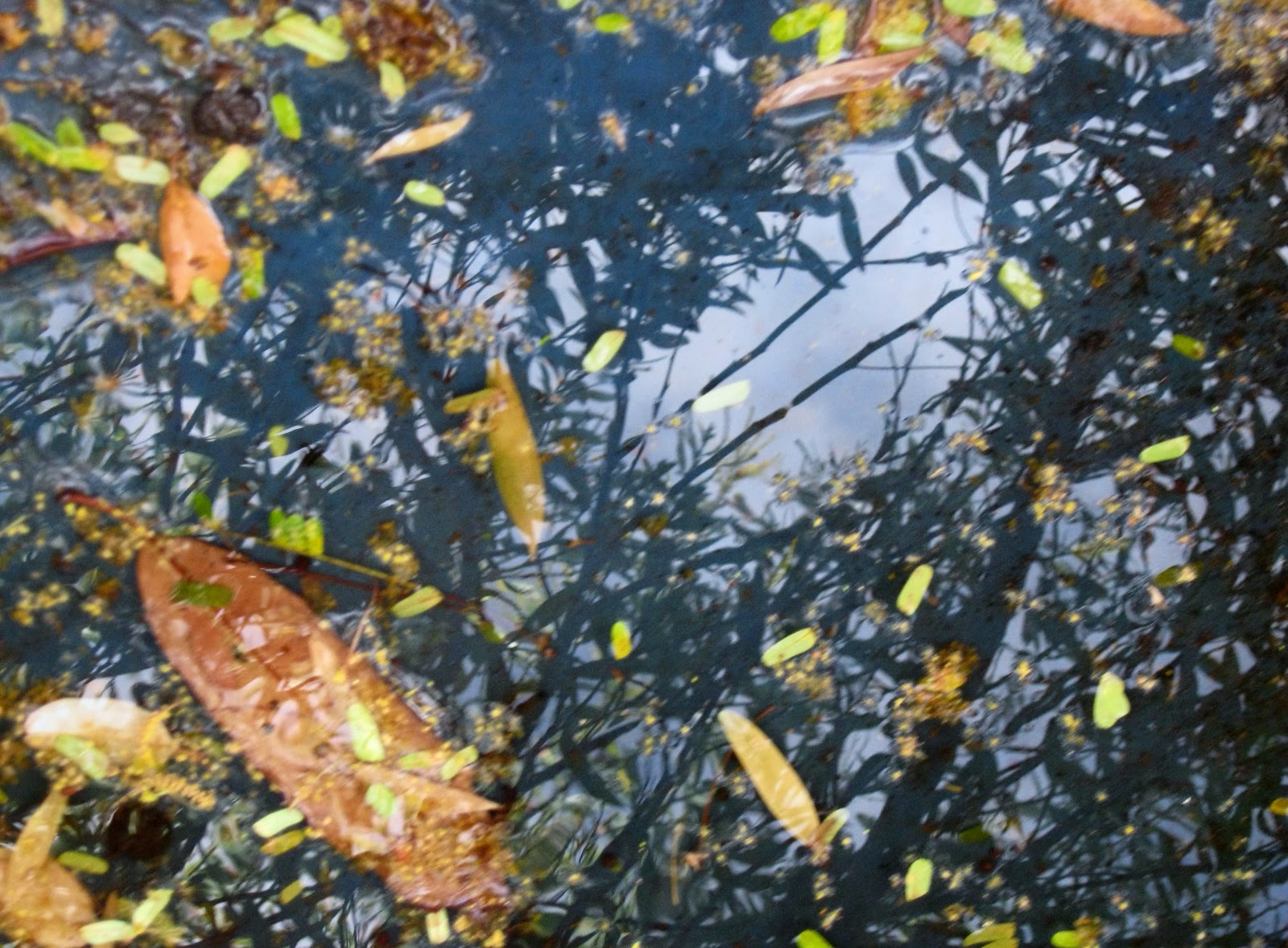
Looking increasingly troppo, Darwin and Townsville residents are sweltering and wandering what has happened to the rain bearing monsoons . Territory cattlemen are worried because grass will not germinate without rain , providing a grim outlook for Dry season grazing. In North Queensland, barramundi  fishermen blame the  poor catch on the lack of monsoonal rain . Ants are also making their presence felt in houses , appearing in large numbers , steams of them heading into ceilings as if to indicate a tsunami is on the way . They have also taken an alarming interest in  my computer ; when I slipped into the parliamentary library in Darwin to snaffle some more state secrets, they emerged by the score and  I surreptitiously squashed them. Don’t be surprised if  the next sitting of the Legislative Assembly proves to be itchy and scratchy. This torrid situation inspired  our irritable resident artist -“Jack the Dripper” Pollock-to create another masterpiece , drawing on a snapshot of rainwater and  blown wattle and  leaves reflected in a blue wheelbarrow.